


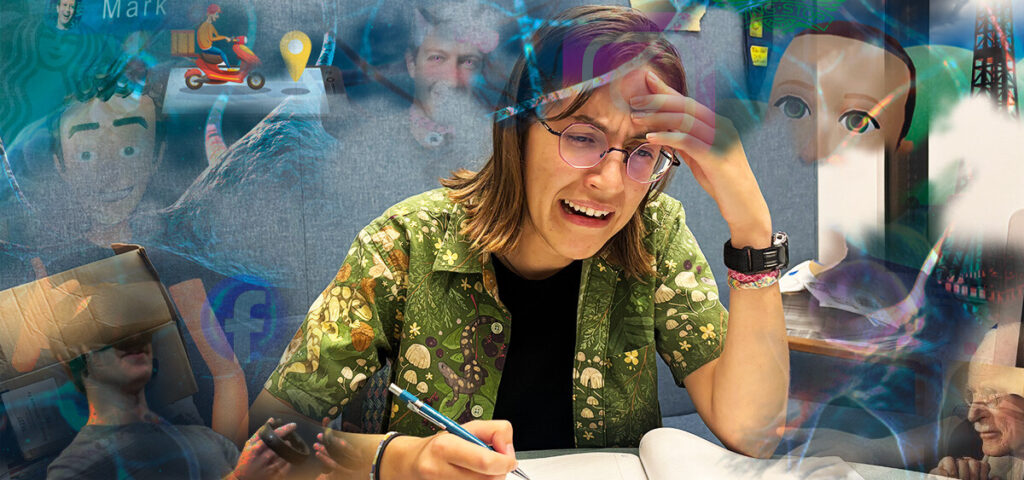
“I tried to watch ‘The Social Network’ last week, and they deleted my occipital lobe,” said one user.
Photo by Amit Roth
Meta’s Metaverse, formerly known as Facebook’s Metaverse, launched in late 2021. A service similar to VR-Chat, another public online world, Metaverse has been deemed “the easiest $36 billion Zuckerberg has lost.” Four years and another $36 billion later, the Metaverse consistently boasts a concurrent player count of 30.
“I just don’t get it!” said Meta Platforms CEO Mark Zuckerberg. “It’s the only reason I changed our name to Meta. And it’s so easy to log in! One VR headset, one free app store download…You could’ve experienced the complexly immersive worlds of humanity’s imagination in the time it took for me to say all this! In that next breath, you could’ve been collecting virtual land tax on your centralized Metaverse properties! Screw this, I have a hair curling appointment and ATV photoshoot after this.”
The Metaverse was previously only available for download on the Apple App Store, Google Play Store, and the Meta Store until earlier this October, when it was ported to humanity’s collective unconscious. Psychologist Carl Jung proposed that such an unconsciousness referred to a shared set of symbols and connotations present in unconnected cultures of the world. Silicon Valley discovered that those symbols could also include sprawling metropolises of western historical monuments; a smooth-faced, yassified Mark Zuckerberg avatar; and product placements.
Kyler Java, Meta employee and the first registered psychoware engineer on LinkedIn, elaborated on the mechanisms of the new Meta venture. “Your unconscious mind can hold a few gigs of RAM at a time,” she said. “Multiply that by eight billion…Right, it works by hosting the server in the betweens of the abstract platonic ideal of the world around us. The Metaphysical — it’s funny, it’s a joke we say a lot in the office — world we share. It should be even easier to log in on this port, I mean, we all have it in our heads and in the cosmic space where the concept of ‘knowing’ rests. So, no excuses. No, we have gone beyond needing to be around other human minds like Wi-Fi towers; that’s the whole point of meeting your friends online, you can do it from home every day. What else…We still have virtual landlording and business owning that I’m legally required to mention. We’ve closed suggestions for ways to make the new Metaverse actually new because, for one, we opened a survey which went to everyone’s spam thalamus — which should’ve been resolved — and two, the last implemented idea was a hypothetical of a robotic snake god that, when uploaded to the first few million people, got out of hand really quickly. That suggester is, in fact, now the only person blacklisted from humanity’s collective unconscious, our partner on the Meta Ray-Ban product line Rocco Basilico. That’s his name, don’t let him back in, please.”
With concurrent users of the Metaverse now encompassing the total of humanity minus one, major corporations have been pursuing their own unconsciously immersive ad spaces. People have found themselves able to access the Doordash or Wingstop purchase portals at the thought of the concept of hunger, and OpenAI has uploaded GPT-5 in order to “defile” the Turing test. Online retailers made the jump to the metaphysical with discounts dependent on how well consumers can improve the public’s unconscious bias towards the brand.
“AFK” users of the collective consciousness have reported 15-second unskippable ads as well as brain fog when an ad fails to load during periods of low connection.
“Submit to my friend request,” beamed Zuckerberg in a global thought-wave. “I yearn to feel ‘personable,’ and it’s the only reason I kept Facebook online after 2018.”

Amit is a cog in this machine. But doesn't everything run on optic cables or something?